Chicago Public Schools (CPS) does not receive revenues when it pays expenses. As a result, CPS’ cash flow experiences peaks and valleys throughout the year, depending on when revenues and expenditures are received and paid. Furthermore, revenues are generally received later in the fiscal year, while expenditures, which are predominantly payroll, are level across the fiscal year—with the exception of debt service and pensions. The timing of these two large payments (debt service and pensions) occurs just before major revenue receipts of property taxes. These trends in revenues and expenditures, accompanied by a weak cash balance that is not large enough to absorb the differences, put constant cash flow pressure on the District and necessitate the use of cash flow borrowing in the form of Tax Anticipation Notes (TANs) during many parts of the year.
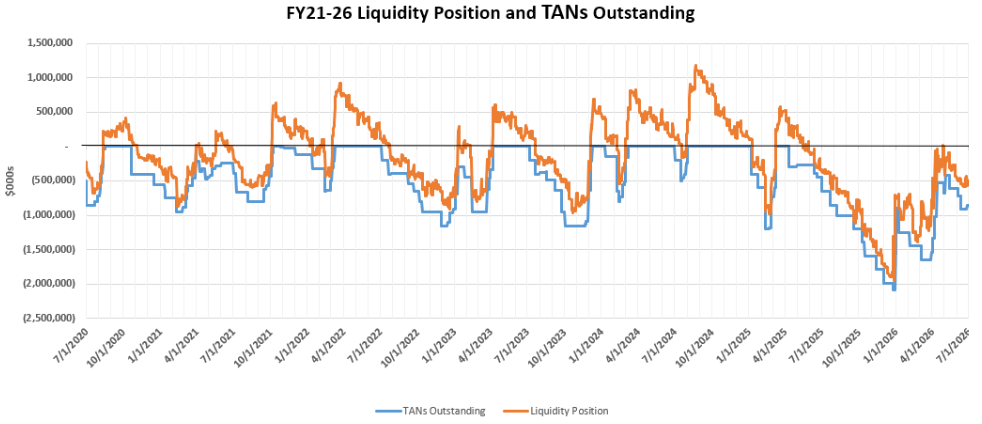
In FY2026, CPS relied more heavily on TANs than in previous years due to delays from Cook County for the second installment of FY2025 property taxes. This was compounded again after Cook County’s delay in the first installment of FY2026 property taxes. TANs were used throughout the year to provide needed liquidity. CPS had a maximum amount of $2.09 billion in TANs outstanding in FY2026 just prior to the second installment of FY2025 property taxes on December 1, 2025. The use of TANs will not be eliminated in FY2027 because year-end cash balances have not increased enough to fund operations for more than 60 days past year-end. CPS also anticipates receiving the second installment of FY2026 property taxes over 2 months late from Cook County on or about October 1, 2026 and will need additional TANs in order to further manage liquidity and replenish the amount of delayed revenues. CPS would need approximately $950 million more than recent year-end cash position amounts in order to eliminate the use of TANs at current FY26 budget levels of expenditures.
In FY2026, approximately $6.1 billion, or 77 percent of CPS’ current year revenues, excluding non-cash items, were received after February—more than halfway into the fiscal year. An annual debt service payment of $379 million was required to be made in mid-February and another $54 million debt service payment was made in March, prior to the receipt of approximately $1.8 billion of the first installment of delayed property tax revenues in April. The goal is to gradually shift more annual debt service payments into March, after the receipt of property tax revenues, in order to reduce reliance on TANs in mid-February. The delay in the first installment of FY2026 property taxes from March to April hampered any cash management efficiencies.
Historically, approximately 55 percent of the annually budgeted CPS expenditures are for payroll and associated taxes, withholding, and employee contributions. In addition, recurring expenses for educational materials, charter school payments, health care, transportation, facilities, and commodities total approximately 30 percent of annual budgeted expenditures. The timing of these payments is relatively predictable and spread throughout the fiscal year. Approximately 15 percent of budget revenues, which flow through the operating account, comprise debt service, annual pension payments, and interest on short-term debt for cash flow borrowing.
Most organizations set aside cash reserves to weather these peaks and valleys in cash flow. For the second time since FY2022, CPS ended the fiscal year with a negative net cash position. The net cash position was pushed lower by an estimated amount of over $300 million in undistributed property taxes from the FY2026 first installment. It consisted of $650 million in outstanding TANs with approximately $63 million in cash—resulting in a net cash position of -$587 million.
Cash Inflows
CPS has four main sources of operating cash inflows: local, state, and federal revenues and working capital short-term borrowing.
- Local Revenues: Local revenues are predominantly property taxes. In FY2026, CPS will receive approximately $4.0 billion of property taxes, of which $3.4 billion will be allocated to the operating fund, $581 million will be distributed to the CTPF through the pension tax levy, and $21 million will be used to fund capital projects through the Capital Improvement Tax levy. Property tax revenues are received from Cook County in two installments. 96 percent of the property tax monies are received from February onward, which is over halfway through any given CPS fiscal year. The delayed first installment of approximately $1.8 billion was due April 1 and was received into the main operating account in late March and April. The second property tax installment to be counted as FY2026 revenues in the amount of approximately $1.7 billion is also anticipated to be delayed and become due on or about October 1, 2026. Property tax receipts have grown from $2.35 billion in FY2012 to $4.0 billion in FY2026—a compounded growth rate of 4.0 percent. Personal Property Replacement Tax (PPRT) revenue increased by approximately 10 percent through June compared to FY2025. Since FY2023, cumulative PPRT receipts through May have declined by 55 percent, dropping from $536 million in FY2023 to $283 million in FY2026.
- State Revenues: State revenues largely comprise Evidence-Based Funding (EBF) and state grants. EBF is received regularly from August through June in bi-monthly installments. In FY2026, EBF totaled approximately 78 percent of the state revenues budgeted by CPS, up from 57 percent in FY2017 before EBF was created. This increase improves cash flow due to the consistency of the payments. Block grant payments are distributed sporadically throughout the year, with the majority of them being received before June 30.
- Federal Revenues: The state administers categorical grants on behalf of the federal government once grants are approved. Approximately 11 percent of the annually budgeted CPS revenues come from federal revenue sources.
- Working Capital Short-Term Borrowing: Under state statute and with Board approval, CPS can issue short-term debt in the form of TANs to address liquidity issues. Borrowing with short-term TANs provides upfront money to pay for expenditures when cash is unavailable, and they allow for repayment of the borrowings when property tax revenues are eventually received. In FY2026, delayed property tax distributions contributed significantly to the maximum amount of $1.65 billion in TANs issued by CPS in February to support liquidity - which was an increase of $450 million compared to FY2025. As of June 30, 2026, $650 million of TANs were outstanding at the end of the fiscal year, an increase of $200 million from FY2025 and largely driven by remaining undistributed property taxes from the past due from the first payment installment in April. TANs are repaid from the District’s property tax levy used to fund operations. To support liquidity in FY2027, CPS is prepared to issue TANs against property taxes as needed, which will allow liquidity to be maintained throughout the year. Short-term borrowing requires that CPS pays interest on the amounts borrowed. For FY2027, approximately $27 million in interest costs for TANs will be budgeted.
Cash Expenditures
CPS expenditures are largely predictable, and the timing of these expenditures can be broken down into three categories: payroll and vendor, debt service, and pensions.
- Payroll and Vendor: Historically, approximately $5.2 billion of CPS’ expenditures are payroll and associated taxes, withholding, and employee contributions. These payments occur every other week, and most expenditures are paid from September through July. In recent years, approximately $2.4 billion of CPS vendor expenses are also relatively stable across the year.
- Debt: Debt service deposits for the payment of bonds that have been issued to fund capital improvements is required to be made once a year on February 15 and March 15 from the state aid EBF revenue that CPS receives. In FY2026, the CPS debt service deposit from EBF was approximately $459 million. In addition to EBF, a portion of the debt service on the bonds that have been issued is paid by PPRTs and/or property taxes deposited directly with the trustee, meaning they do not pass through the District’s operating fund from a cash perspective. The bond documents dictate the timing and amount of these payments. Once the trustees have verified that the debt service deposit is sufficient, they provide a certificate to CPS, which then allows the backup property tax levy that supports the bonds to be abated.
- Pensions:In FY2026, CPS anticipated approximately $30 million would be paid by unrestricted operating revenues to the CTPF before the fiscal year end, however the projected amount of first and second installment dedicated pension property tax levy revenues is now anticipated to cover the full amount. These tax levy revenues, when received, do not pass through the District’s operating funds from a cash perspective (see the Pensions chapter for more detail on FY2026 funding sources).
Forecasted Liquidity
The chart below provides CPS’ liquidity profile from FY2021 to FY2026.
Chart 1: FY2021–FY2026 Operating Liquidity Position